



What is training in design thinking?
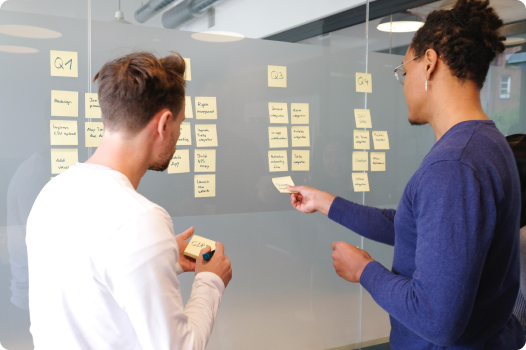
Participants will learn by doing. Small teams will collaborate on a real projects. For example a non-BAU-project. Or you might use a discovery you are about to embark on or something general. You don’t need to come prepared with a deep understanding of the problem we will work through this in the sessions.
What does it include?
Facilitated training sessiosn for 12 participants. This is a hands on collaborative training that works best in small groups. For in person you will require to ahave a space booked in your office. For remote training, all participants need a laptop and Miro access.

With the option to get hands on support sessions to shape your discovery project.

Digitalisation vs. Digitising
Digitization is the process of converting analog information into a digital format, while digitalization involves using digital technologies to transform business processes and create new value.
Are you ready to digitalize your organisation?
Contact me to find out what the trategies are.
Frequently asked questions about our design service
-
A plan or roadmap that lists priorities for design that is aligned to user needs, business needs. Considering desirability, feasibility and viability.
-
The primary goals typically include improving user experience, enhancing service efficiency, and aligning the service with business objectives.
-
We achieve this by conducting user research, including interviews and surveys, to gather insights into user behaviour and preferences.
-
We use various methodologies, such as Design Thinking, Service Blueprinting, and Agile practices, to guide the design process and enhance collaboration.
-
Implementation plans include collaboration with stakeholders to integrate the design into existing systems while ensuring that resources and timelines are appropriately allocated.
-
Stakeholder engagement involves regular workshops, feedback sessions, and updates to ensure their insights and needs are incorporated throughout the design.
-
We create various prototypes, ranging from low-fidelity wireframes for initial concepts to high-fidelity interactive models for user testing and validation.
-
Success is measured through key performance indicators (KPIs), user feedback, and performance metrics to ensure the design meets organizational and user goals.
-
User feedback is collected through surveys, interviews, and usability testing sessions, followed by analysis to identify trends and areas for improvement.
-
We approach this by considering the user journey across all touchpoints, ensuring a consistent experience that is tailored to both digital and physical interactions.